

Grief & Healing
Understanding Continuing Bonds Theory
How contemporary grief research challenges the "let go" model — and what it means for how we support the bereaved.
Read
Guide. Witness. Strategist. Teacher.Helping you navigate grief, spiritual crisis, and transformation with compassion and clarity.
Grief & Afterlife
A grounded exploration of grief, continuing bonds, spiritual experience, transformation, and the deeper questions that emerge after profound loss.
Understanding Grief
Most of us were taught — directly or by omission — that grief is something to pass through. The stages. The work of acceptance. The gradual relinquishing of attachment until the love we carry for someone who has died quietens itself into something manageable.
Contemporary grief science has moved beyond this model. Not because loss gets easier — it doesn't, not exactly — but because the framework that described grief as a linear passage toward resolution did not match what bereaved people were actually living. It did not account for the non-linearity of grief: the way it returns, the way it transforms, the way it is inseparable from the love it follows.
Grief is not the opposite of living fully. It is love with nowhere left to go — until it finds a new form.
Research Insight
Transformation after loss is possible — not in the sense that the loss is redeemed or justified, but in the sense that human beings can carry even the heaviest things with grace. Jock's work creates the conditions for this kind of carrying — patient, grounded, and deeply respectful of the specific, irreducible weight of what you have lost.
You do not need to stop loving someone in order to live fully again. Grief is not the enemy of life — it is the guardian of love.
Jock Brocas
Every Form of Loss
Grief does not arrive in tidy categories. It arrives as the specific, irreducible weight of the love you had. All of it deserves care.
The death of a life companion carries a particular weight — the loss of shared history, daily presence, and the person who knew you most completely. This work honours that depth without minimising it.
No grief is more dislocating. The death of a child inverts the natural order and leaves a wound unlike any other. Jock's work meets this grief with the seriousness and tenderness it demands.
The death of a parent — even when expected — can shake identity to its foundation. Family grief carries layers of history, complexity, and love that deserve careful, unhurried attention.
When death arrives without warning — through accident, violence, or sudden illness — the shock compounds the grief in ways that conventional support often struggles to reach.
The grief that follows the death of a beloved animal, the loss of a relationship, or any loss the world refuses to acknowledge. Real, significant, and deserving of the same care as any other.
Sometimes what dies is not a person but a belief — in a benevolent universe, in the framework that once gave life meaning. This form of grief is quiet, lonely, and deeply significant.
Begin Here
Grief is not a single experience. It arrives differently for each person — at different moments, at different depths, with different questions. Begin wherever you are.
Continuing Bonds & Experience
Many bereaved people have experiences they do not share widely — not because they are uncertain they happened, but because they are uncertain how they will be received. A sense of presence. A dream that felt unmistakably real. A sign that arrived with a quality of intention that defied easy explanation.
These experiences are more common than most people realise. They deserve a grounded, compassionate framework — not dismissal, and not uncritical amplification.
Clinical Perspective
Common Experiences
Visitation Dreams
Dreams in which the bereaved feel they have had a genuine encounter with someone who has died — distinguished by a quality of presence, lucidity, and emotional weight that differs markedly from ordinary dreaming.
Sensed Presence
The felt sense that someone who has died is near — sometimes accompanied by warmth, a familiar scent, or a quality of attention that is difficult to put into words.
Symbolic & Meaningful Coincidence
Events that arrive with a felt quality of intention — a particular bird, a song that plays unexpectedly, a name appearing at a significant moment.
After-Death Communication
Spontaneous experiences of apparent contact from someone who has died — through dreams, waking encounters, or inexplicable phenomena.
Spiritual Emergence After Loss
Grief is one of the most powerful catalysts for spiritual opening known to human beings.
Identity Disruption & Reconstruction
When someone who was central to your sense of self dies, you lose more than their presence.
We don't heal by forgetting.
We heal by remembering the love that remains.
Jock Brocas
Featured Conversations
Books & Teachings
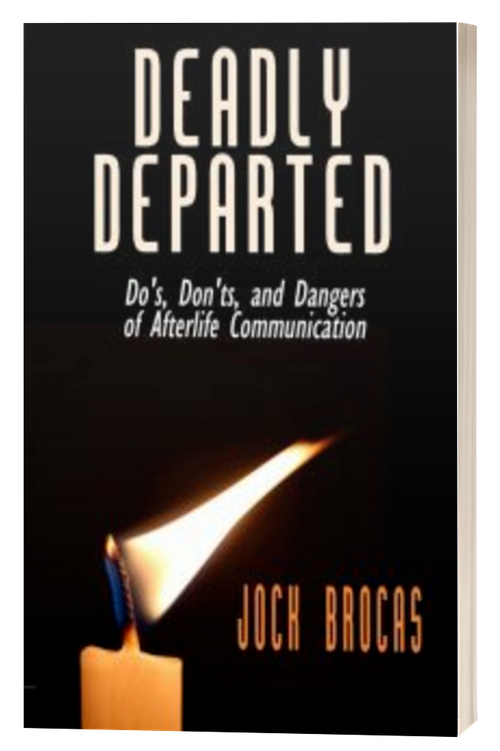
Jock has written extensively on grief, the afterlife, consciousness, and evidential mediumship — not to establish a brand, but because these subjects demanded to be written about clearly and without sensationalism.
Browse All BooksResources & Guidance
Courses, recordings, and curated resources coming.
Jock is developing a series of guided resources for those navigating grief, spiritual crisis, and the deeper questions. Subscribe to hear first.
Start HereRecommended Reading
Common Questions
The work does not end on this page. It continues in essays, reflections, and conversations published through the journal.
Occasional and considered. Written when there is something worth saying.
Compass & Signal
Ongoing essays, reflections, and research on grief, consciousness, and meaning are published through Compass & Signal — delivered to those who wish to read.
Explore the Journey
Each area of this work opens a different door into grief, meaning, and the deeper questions that loss can open.
A Reflection
Whether that is a recent loss, a grief that has been present for years, an experience you cannot fully explain, or a quiet sense that there must be something more to what has happened — you arrived here with something that matters.
Grief is not the end of the story. For many, it is the beginning of a deeper one.
What this work offers is not relief from grief — that is not something anyone can promise — but a grounded, compassionate space to explore what grief opens: the questions about love, about continuity, about what remains after loss, and about who you are becoming in its aftermath.
There is no single path. There is only the next step, taken with as much honesty and tenderness as you can bring to it.
Private Guidance
For those navigating grief, continuing bonds, afterlife questions, or spiritual crisis after loss, private guidance can offer a grounded space to explore what remains, what changes, and what still seeks meaning.